As Chinese suppliers were shut down in the last few weeks due to the bad weather and Chinese holiday, American market participants reported to Asian Metal that antimony trioxide is selling at higher prices than two weeks ago.
A Chinese representative located in U.S. disclosed that he is selling 99.5%min antimony trioxide at USD2.55/lb d.d.p. to American consumers, and the material shipped to U.S. ports is in the range of USD5,400-5,500/t CIF Baltimore.
According to him, the price had increased fast in America in the last two weeks that the price before Chinese New Year was at around USD2.40-2.45/lb d.d.p. and now increased by USD0.10-0.15/lb. However, he holds that the price will not go up further because many consumers and traders have stock on hand to last about a month before the new material arrives America from China.
An official from a Eastern coast consumer reported to Asian Metal that the antimony trioxide price is about USD5,500/t CIF U.S. port for 99.5%min normal brand material, and the price had increased in the last couple of weeks. He heard the snowstorm in China, and thinks this could be the reason for increasing price.
According to him, the demand of antimony trioxide is very active in the American market. He holds that the increasing price will not affect the antimony demand as they are more focused on keeping normal production....
read more
Saturday, February 16, 2008
Saturday, February 02, 2008
[+/-] : Antimony products market stagnant-Antimony market summary Jan 21-25
Antimony market sees few activities during the week as traffic in many parts of Souch China has come to a standstill due to the infrequent heavy snow. However, most Chinese smelters hold high offers of antimony ingot and trioxide, expecting a better market after the Spring Festival.
Both major producers and small scaled smelters have been troubled by the traffic chaos, and many of them were forced to reduce or even halt production due to short supply of raw materials. Meanwhile, few concluded deals have been reported as it is hard to transport goods out of smelters to end users or ports. Considering the market supply may be tighter if more smelters stop production before the Spring Festival, many smelters take high expectations towards the market after the Spring Festival, and therefore insist on high quotations. Some major producers cease quoting and some quote as high as RMB40,000/t (USD5,548/t) ex works to keep buyers away, but limited deals were concluded at prices above RMB39,000/t (USD5,409/t) ex works. Meanwhile, small smelters in Lengshuijiang also hold the offer of around RMB37,000-37,300/t (USD5,132-5,173/t) VAT excluded, but few deals were closed due to the transportation difficulty.
Antimony trioxide producers also encounter the same problem that raw material supply is erratic and price goes higher. Therefore, many of them raise offers to RMB36,000-36,500/t (USD4,993-5,062/t) ex works. However, due to the bad traffic condition, little new business has been done during the week, and many producers are trying their best to fulfill the signed contracts, many of which were concluded at RMB34,500- 35,000/t (USD4,785-4,854/t) ex works.
Prompted by higher quotations in Chinese domestic market, temporary tight supply caused by bad traffic condition as well as appreciation of RMB, suppliers also raise export quotations of antimony ingot and trioxide greatly. Foreign buyers reported that they received higher offers of USD5,600-5,650/t CIF Rotterdam for strandard grade-two antimony ingot, USD50-100/t higher compared to two weeks ago. Meanwhile, Chinese traders continue to raise quotations of antimony trioxide to USD4,900-4,950/t FOB from USD4,850-4,900/t FOB the previous week, though few deals were reported. Meanwhile, Hsikwangshan insists on a higher offer of USD5,000/t FOB for its Twinkling Star antimony trioxide as the supply turns tigher led by short supply of raw material....
read more
Both major producers and small scaled smelters have been troubled by the traffic chaos, and many of them were forced to reduce or even halt production due to short supply of raw materials. Meanwhile, few concluded deals have been reported as it is hard to transport goods out of smelters to end users or ports. Considering the market supply may be tighter if more smelters stop production before the Spring Festival, many smelters take high expectations towards the market after the Spring Festival, and therefore insist on high quotations. Some major producers cease quoting and some quote as high as RMB40,000/t (USD5,548/t) ex works to keep buyers away, but limited deals were concluded at prices above RMB39,000/t (USD5,409/t) ex works. Meanwhile, small smelters in Lengshuijiang also hold the offer of around RMB37,000-37,300/t (USD5,132-5,173/t) VAT excluded, but few deals were closed due to the transportation difficulty.
Antimony trioxide producers also encounter the same problem that raw material supply is erratic and price goes higher. Therefore, many of them raise offers to RMB36,000-36,500/t (USD4,993-5,062/t) ex works. However, due to the bad traffic condition, little new business has been done during the week, and many producers are trying their best to fulfill the signed contracts, many of which were concluded at RMB34,500- 35,000/t (USD4,785-4,854/t) ex works.
Prompted by higher quotations in Chinese domestic market, temporary tight supply caused by bad traffic condition as well as appreciation of RMB, suppliers also raise export quotations of antimony ingot and trioxide greatly. Foreign buyers reported that they received higher offers of USD5,600-5,650/t CIF Rotterdam for strandard grade-two antimony ingot, USD50-100/t higher compared to two weeks ago. Meanwhile, Chinese traders continue to raise quotations of antimony trioxide to USD4,900-4,950/t FOB from USD4,850-4,900/t FOB the previous week, though few deals were reported. Meanwhile, Hsikwangshan insists on a higher offer of USD5,000/t FOB for its Twinkling Star antimony trioxide as the supply turns tigher led by short supply of raw material....
read more
[+/-] : China Antimony products market&supply tight affected by heavy snow
Snowstorms raging across China's Hunan Province have lasted for two weeks, making the traffic situation graver in the province. Many antimony ingot and trioxide smelters have been forced to halt production due to lack of raw materials and power shortage. Coupled with the great difficulty in conveying goods, the antimony products market has come to a standstill.
A Hunan-based antimony ingot producer, with a capacity of 3,000tpy, stopped production ahead of schedule last week due to the harsh weather. According to an official from the smelter, Hunan province suffered its coldest winter as well as the longest snowfall in record in the past 50 years. Many antimony ingot and trioxide smelters in Loudi and Yiyang, the major antimony products producing areas, closed down due to the severe weather.
Located in the mountainous area, the smelter had great difficulty in transporting raw materials in and products out. It also delayed the delivery of contracted materials as the roads are covered with snow and ice.
The smelter sold some antimony ingot at and slightly above RMB39,000/t (USD5,417/t) ex works in the middle of January and suspended quoting a week ago when the weather condition worsens. "The market is likely to stay stagnant till the middle of February when participants return from the Spring Festival holiday," said the source.
A Guangdong-based trader said that all the contracted antimony trioxide will not be delivered on time to overseas customers due to the traffic chaos. "Heavy snow has paralyzed China's traffic. Combined with the Chinese New Year travel peak, it's impossible to deliver goods from smelters to ports now," said the source
The source confirmed that the antimony products market becomes quieter as traffic condition worsens. Most smelters suspend offering and plan to sell after the Spring Festival. The source received offers of USD4,900-5,000/t FOB China for antimony trioxide late last week, USD100/t up compared to the price two weeks ago, but none of his customers would like to purchase at the increased price....
read more
A Hunan-based antimony ingot producer, with a capacity of 3,000tpy, stopped production ahead of schedule last week due to the harsh weather. According to an official from the smelter, Hunan province suffered its coldest winter as well as the longest snowfall in record in the past 50 years. Many antimony ingot and trioxide smelters in Loudi and Yiyang, the major antimony products producing areas, closed down due to the severe weather.
Located in the mountainous area, the smelter had great difficulty in transporting raw materials in and products out. It also delayed the delivery of contracted materials as the roads are covered with snow and ice.
The smelter sold some antimony ingot at and slightly above RMB39,000/t (USD5,417/t) ex works in the middle of January and suspended quoting a week ago when the weather condition worsens. "The market is likely to stay stagnant till the middle of February when participants return from the Spring Festival holiday," said the source.
A Guangdong-based trader said that all the contracted antimony trioxide will not be delivered on time to overseas customers due to the traffic chaos. "Heavy snow has paralyzed China's traffic. Combined with the Chinese New Year travel peak, it's impossible to deliver goods from smelters to ports now," said the source
The source confirmed that the antimony products market becomes quieter as traffic condition worsens. Most smelters suspend offering and plan to sell after the Spring Festival. The source received offers of USD4,900-5,000/t FOB China for antimony trioxide late last week, USD100/t up compared to the price two weeks ago, but none of his customers would like to purchase at the increased price....
read more
Wednesday, January 16, 2008
[+/-] : Antimony trioxide
Antimony trioxide is not a flame retardant per se, but it is...
used as a synergist. It is utilized in plastics, rubbers, textiles,
paper and paints, typically 2-10% by weight, with organochlorine and
organobromine compounds to diminish the flammability of a wide range
of plastics and textiles (IARC, 1989).
Antimony oxides and antimonates must be converted to volatile
species. This is usually accomplished by release of halogen acids at
fire temperatures. The halogen acids react with the antimony-
containing materials to form antimony trihalide and/or antimony halide
oxide. These materials act both in the substrate (condensed phase)
and in the flame to suppress flame propagation. In the condensed
phase, they promote char formation, which acts as a physical barrier
to flame and inhibits the volatilization of flammable materials. In
the flame, the antimony halides and halide oxides, generated in
sufficient volume, provide an inert gas blanket over the substrate,
thus excluding oxygen and preventing flame spread. These compounds
alter the chemical reactions occurring at fire temperatures in the
flame, thus reducing the ease with which oxygen can combine with the
volatile products. It is also suggested that antimony oxychloride or
trichloride reduces the rate at which the halogen leaves the flame
zone, thus increasing the probability of reaction with the reactive
species. Antimony trichloride probably evolves heavy vapours which
form a layer over the condensed phase, stop oxygen attack and thus
choke the flame. It is also assumed that the liquid and solid
antimony trichloride particles contained in the gas phase reduce the
energy content of the flames by wall or surface effects (Troitzsch,
1990).
Other antimony compounds include antimony pentoxide, available
primarily as a stable colloid or as a redispersible powder. It is
designed primarily for highly specialized applications, although
manufacturers suggest it has potential use in fibre and fabric
treatment.
Sodium antimonate (Na2OSb2 O5Ê´H2O) is recommended for
formulations in which deep tone colours are required or where antimony
trioxide may promote unwanted chemical reactions.
read more
[+/-] : Antimony oxide price spiral draws attention to alternatives-1994
 Driven by an unbalanced supply-demand situation, prices of antimony oxide have climbed steeply this year with no end in sight. The result has been a scramble to reformulate where possible. Compounders that haven't actively considered alternative flame-retardant synergisms since the last time antimony experienced unstable market conditions are reacquainting themselves with the likes of zinc borate and other zinc compounds, as well as compounds of Mo and Tin,
 HIGH AND GOING HIGHER
Since late last year, prices of antimony metal have more than tripled while prices of the oxide have more than doubled. Through most of 1993, antimony oxide sold for $1/lb or a bit less. Prices now are about $3/lb and could go higher this month. Antimony oxide suppliers, consultants and other industry sources do not expect any relief soon.
But as in past instances (in the late- 1970s and mid-'80s) where antimony went through similar dramatic price/supply fluctuations, this situation will stabilize eventually. When that happens, one FR synergist supplier expects antimony oxide to hover around $2/lb. "I doubt we'll see the former lower levels," he says.
The main cause of the price increases is price setting by central planners in the People's Republic of China, the largest producer of antimony metal.
However, China and another producer, Bolivia, are suffering from depletion of reserves, while mine closings in places like Canada, Mexico, Bolivia, and Turkey have contributed to shortages in antimony metal. At the same time, demand is strong in the U.S.- up 10% so far this year - and in the Far East and developing countries.
Industry observers expect that old mines, particularly in Central and South America, will be reopened. But the time required to do so ranges from six months to a more likely 12-18 months.
SEARCH FOR ALTERNATIVES
Despite the runup in prices, no one expects to see large-scale replacement of antimony oxide in the near future. One industry source guesses that serious efforts at substitution won't come until and unless the oxide reaches $5.50/lb. For now, most of the reformulation activity is aimed at lowering the amount of antimony used - either by increasing the halogen content in the case of brominated FR additives or by partially replacing the synergist with another additive.
According to one supplier of brominated FR compounds, formulators have traditionally used bromine and antimony oxide at a 3:1 ratio, respectively. But with the rising cost of antimony oxide most are now going to a 4:1 ratio. "Three to one is believed to be the ideal ratio. An increase of the halogen fraction is likely to decrease the flame-retardant efficiency of the additive package but it does allow for cost containment," notes Dr. Marcelo Hirschler, a consultant on flame retardants based in Rocky River, Ohio.
According to consultant James Innes of Flame Retardants Associates, Naperville, Ill., the first major target for partial antimony replacement is PVC, as it is the most cost-sensitive application for the synergist. Other targets include polyolefins, PS, ABS, and engineering resins such as nylon and PBT. However, far less research has been done on synergism with bromine flame retardants than with PVC.
The consensus is that no alternative synergist is a true drop-in substitute for antimony oxide, making combination systems with antimony more likely. The more stringent the fire test that an end product must pass, the lower the likelihood that any alternative compound alone will suffice, notes Hirschler.
ZINC BORATE
"When people are looking to reformulate, we always start with zinc borate because it is still selling at less than half the price of antimony oxide. In flexible PVC, you can replace up to 50% of the antimony, depending on the applications," says Larry Musselman, technical director of the Polymer Additives Group of minerals supplier R.J. Marshall, Southfield, Mich. (The company supplies magnesium hydroxide, alumina trihydrate, molybdenum compounds, and a family of low-smoke inorganic complexes.)
Based on current market prices for zinc borate at $1.00-1.29/lb, partial replacement of antimony oxide with zinc borate can result in a cost reduction of 25-40% of the total synergist package.
Zinc borate can replace antimony oxide in whole or in part, depending on the resin and the flame-resistance specification, says Dr. Kelvin Shen, market development manager at leading zinc borate producer U.S. Borax, Inc., Valencia, Calif. "For example, in flexible PVC you want to use a high ratio of zinc borate to antimony oxide to achieve low smoke and good flammability performance."
To address the supply shortage and help users cut costs, Anzon Div. of Cookson Specialty Additives, Philadelphia, is working on synergistic systems of antimony oxide with zinc borate for flexible PVC applications such as wire and cable. Anzon, a long-time antimony oxide supplier, recently acquired the zinc borate business of Climax Metals Co., Englewood, Colo. (CIRCLE 26)
Beyond PVC, there is potential for replacing antimony with zinc borate in most halogenated systems, including polyolefins and styrenics, at typical use levels of 3-15 phr, says Shen. "In HIPS and ABS, you can replace up to 50% of the antimony and in PVC, nylon, or epoxy you can completely replace it with zinc borate."
Unlike antimony oxide, zinc borate also functions as a smoke and afterglow suppressant ,and in most systems, it works synergistically with antimony oxide. In other words, flame resitance may be improved by partial substitution of antimony with equal parts of zinc borate. HIPS and ABS are exceptions in that synergism has not been observed, but fire-test performance is not reduced with zinc borate/antimony combinations, Shen says.
Besides its standard Firebrake ZB grade, U.S. Borax has experimental Firebrake 415 and 500 grades, both with higher thermal stability (over 770 F) for use in engineering resins. (CIRCLE 30)
MOLYBDENUM COMPOUNDS
Molybdenum compounds are other synergists that can be used to partially or totally replace antimony oxide, says consultant Innes. Like zinc borate, molybdenum compounds function synergistically with halogen flame retardants and suppress smoke as well as flame. And as with zinc borate, most experience with molybdenum has been in PVC, particularly flexibles. Innes says it's "easy" to meet some less stringent flame specifications with molybdenum compounds; but in "applications where fire tests are very tough, such as plenum wire and cable jacketing, you cannot totally replace antimony."
Pure molybdenum compounds that can be used as flame and smoke suppressants are supplied by Climax Molybdenum Co., Pittsburgh, and R.J. Marshall's Polymer Additives Group. They typically cost $4-5/lb. (CIRCLE 43)
Pure molybdenum compounds from Climax Molybdenum include molybdenum trioxide, which sells for a bit under $4/lb, and ammonium octamolybdate, priced at $4-5/lb. Senior technical sales representative Bill Kennelly says these compounds can replace up to 50% of antimony oxide without a reduction in LOI (oxygen index). Kennelly says a side advantage is a drastic reduction in smoke. Besides flexible and rigid PVC, pure molybdenum compounds have been shown to work as total replacements for antimony oxide in brominated epoxies and as partial replacements in thermoset polyesters, Kennelly says. "Generally, these compounds work best where the halogen is part of the backbone of the polymer rather than applied as an additive," he adds.
Sherwin-Williams Chemicals,Kans. (for which Innes consults), supplies Kemgard complex inorganic compounds of molybdenum with calcium and/or zinc. These molybdenum compounds are extended on an inert pigment core to lower their cost (92cents-$1.29/lb), according to technical services manager Charles Simpson. These products are said to provide smoke-suppressant performance similar to pure molybdenum compounds but require higher use levels - typically 2-10 phr vs. 1-5 phr. At current market prices, partial replacement of antimony oxide with Kemgard can reduce flame-retardant costs by 20-50%, Simpson says.
The Kemgard family includes grades 911A and 425 molybdenum/calcium/zinc complexes for PVC plastisols, wire/cable coatings, wall coverings, and calendered films. Kemgard 911C molybdenum/zinc complex is for flexible and rigid PVC where increased thermal stability is required. Kemgard 981 is a zinc-phosphate/molybdenum additive for calendered PVC upholstery and polyolefins. (CIRCLE 44)
TIN COMPOUNDS
Tin compounds such as zinc stannate are the alternative that most closely approaches a direct replacement for antimony oxide in halogen flame-retardant systems, according to James Innes and other industry sources. As is the case with pure molybdenum compounds, however, they come at a cost premium.
Notes consultant Hirschler, "The key advantage of tin compounds over antimony oxide is that they also act as very effective smoke suppressants, while antimony may actually increase smoke production per unit of mass burnt. And there's no need for any significant change in use levels."
Cleveland-based Alcan Chemicals has been offering Flamtard S zinc stannate (51% tin content) since 1989 as a drop-in replacement for antimony oxide, according to marketing manager Ray Shaw. The product sells for $5.50/lb. A lower-cost version with lower temperature stability is also now offered. This Flamtard H is a zinc hydroxy stannate designed for PVC that is processed below 400 F. It sells for $4.50/lb. Typical use range of these products is 1-5 phr.
Alcan has established that Flamtard S works well in both flexible and rigid PVC, chlorinated PE (used in foams and some wire/cable compounds), brominated unsaturated polyester resins for composites, nylon, and PE. Regarding the latter, Shaw recommends Flamtard S for use with chlorinated paraffins instead of bromine compounds. (CIRCLE 45) .
ENDOTHERMIC CHAR FORMERS
For the last year, R.J. Marshall's Polymer Additives Group has been marketing a family of proprietary flame-retardant complexes as partial or total replacements for antimony oxide in many halogen-containing systems, including urethanes, polyolefins, and nylon. "Most of our work has involved flexible and rigid PVC, but we have shown it to work successfully in other systems," he says.
The Charmax LS family includes four grades that have both an endothermic (heat-absorbing) mechanism, like ATH and magnesium hydroxide, and a char-forming mechanism, typical of zinc borate or molybdenum compounds. Says Musselman, "By using a range of elements to match an endothermic with a char-forming mechanism, we can address specific requirements for each polymer system. We're trying to deal with both flame retardancy and smoke suppression. We can get the same results with Charmax LS at lower cost as we can with our straight molybdenum."
Charmax LS complexes may include different combinations of molybdenum, zinc borate, ATH, or tin compounds, such as zinc stannate. These complexes are said to avoid the problems of using their individual components singly, such as degradation of physical properties and loss of uv or thermal stability. Charmax LS compounds sell for $1.00-1.75/lb and are typically used at 2-10 phr. ...
read more
[+/-] : Flame retardants in U.S. market predicted to see healthy growth
The demand for flame retardant products in the U.S. is projected to
increase by 6.5% per year to $1.3 billion through 2008, according to
"Flame Retardants," a new study from The Freedonia Group, Inc., a
Cleveland, OH-based market research firm. The volume of flame
retardant materials is expected to grow by 3.1% per year, reaching one
billion pounds by 2008.
increase by 6.5% per year to $1.3 billion through 2008, according to
"Flame Retardants," a new study from The Freedonia Group, Inc., a
Cleveland, OH-based market research firm. The volume of flame
retardant materials is expected to grow by 3.1% per year, reaching one
billion pounds by 2008.
[ILLUSTRATION OMITTED]
Higher value specialty products, especially those that have favorable
environmental profiles, will continue to increase their market share.
Bromine and phosphorus compounds antimony trioxide (ATO) and magnesium
dehydrate (MDH) are expected to see the strongest gains. The product
with the largest volume usage, alumina trihydrate (ATH), will continue
to grow and maintain its number one volume ranking, but it will
increase at a slower rate than other flame relardant products.
However, the environmental restrictions on a range of chlorinated,
fluorinated, and brominated materials are affecting the growth of this
sector of the flame retardants industry. Chlorinated products, in
particular, are expected to post negligible gains. While restrictions
have been put in place, the report states that it sees no indication
that a complete ban on these materials will be implemented in either
the U.S. or Europe.
A main reason cited for the overall continued growth of the flame
retardant industry is the increasing use of plastics as a substitute
for metal and glass in many kinds of products. Since plastic is
inherently more flammable than most of the materials it replaces, the
need for flame retardant coatings is increasing and now plastics have
become the primary end use product for flame retardants. More details
on the report can be found at www.freedoniagroup.com....
read more
[+/-] : Flame retardant market growing
According to an updated technical market research report, "Flame
retardant chemicals--RC-004B," from BCC Research, the consumption of
flame retardant chemicals worldwide was 2.9 billion pounds in 2005.
This amount will grow at an average annual growth rate of 3.5% and
reach 3.4 billion pounds in 2010. Price increases for most products,
except alumina trihydrate, would impact the average annual growth rate
of the market's sales. In 2005, sales were estimated to be
approximately $3.5 billion worldwide. This figure should reach $4.6
billion by 2010, with an average annual growth rate of 5.6%.
retardant chemicals--RC-004B," from BCC Research, the consumption of
flame retardant chemicals worldwide was 2.9 billion pounds in 2005.
This amount will grow at an average annual growth rate of 3.5% and
reach 3.4 billion pounds in 2010. Price increases for most products,
except alumina trihydrate, would impact the average annual growth rate
of the market's sales. In 2005, sales were estimated to be
approximately $3.5 billion worldwide. This figure should reach $4.6
billion by 2010, with an average annual growth rate of 5.6%.
The greatest growth by volume will be for bromine- based,
phosphorus-based and melamine-based flame retardants, due to growth
rates in plastics and wood/paper applications. Melamine is a small
market player with slightly more than 1% share of the flame retardant
chemicals marketplace. The growth for the use of melamine is expected
to be greater than the industry as a whole, since melamine is being
used more often as a flame retardant in plastics and in coatings. In
addition, melamine should have increased presence in Europe, where
there are bans on the use of certain bromine-based flame retardant
chemicals. In such cases, it is possible to use melamine-based flame
retardant chemicals as an alternative.
The continuation of fire safety standards in the U.S. and abroad will
spur flame retardant growth. Additionally, the largest country in the
world, China, has opened its borders to Western products, providing
new opportunities for companies with the ability to do business in the
region. Environmental and health concerns over halogenated flame
retardant chemicals should also allow additional market share for
halogen replacements, especially in parts of Europe where bans on
specific halogenated chemicals exist.
Alumina trihydrate should continue to dominate the market by volume
with an estimated 42% market share. Prices for alumina trihydrate have
not gone up much in the last five years and are not expected to in the
furore. As a result, the volume growth of ATH should be similar to
that of sales growth, about 2%....
read more
[+/-] : China's Demand for Flame Retardant Has Grown at a Fast Pace in the Past Decade
Research and Markets has announced the addition of "Chinese Markets
for Flame Retardant 2006" to their offering.
for Flame Retardant 2006" to their offering.
China has experienced over two decades of high economic growth, which
has been stimulated by the consecutive increases of industrial output,
consumer consumption and capital investment. China's GDP has been
growing at 9.8% per annum. National industry output has been advancing
at 15% annually and will continue to sustain a strong growth into the
next decade. The fast-growing middle class is creating an enormous
consumer society. As the fastest-growing economy in the world, the
emerging market has attracted the attention of investors and
corporations around the world for the last two decades.
To deepen the reform of state-owned enterprises is a long-term task
and needs great efforts. The reform of state-owned economy has
witnessed rapid changes in both economic and social aspects. The
introduction of foreign advanced technology and capitals will continue
to be favoured by the Chinese government and business community. New
ways will be adopted to utilize foreign investment, including mergers,
acquisition, and investment funds and securities investment. China
will continue to improve its investment environment in the areas of
legal system, intellectual property protection, foreign trade and
investment regulation, infrastructure and financial system. China is
the second largest foreign investment recipient after the United
States in the world today. Given its vast market, the country provides
tremendous opportunities for investment and trade both for the present
and future.
China's demand for flame retardant has grown at a fast pace in the
past decade. In the next five years, both production and demand will
continue to grow. This new study examines China's economic trends,
investment environment, industry development, supply and demand,
industry capacity, industry structure, marketing channels and major
industry participants. Historical data (1995, 2000 and 2005) and
long-term forecasts through 2010 and 2015 are presented. Major
producers in China are profiled.
Report Scope and Methodology
This report about the China flame-retardants market examines China's
macroeconomic trends, investment environment, flame-retardants
industry structure and capacities, production and demand, end-user
market consumption trends, distribution channels and trading
companies, major research institutes and principal industry
participants. Long-term forecasts for major flame-retardants
production and demand are included. Major producers and end-users of
flame-retardants are profiled and listed in the producer directory
section.
Both primary and secondary research was done in China in order to
access up-to-date government publications, market information and
industry data. Data were collected from the Chinese government
publications, Chinese chemical industry associations, local
governments' chemical industry bureaus, and the Internet. Interviews
are conducted with Chinese industry experts, university professors,
and flame-retardants producers in China. Historical data includes the
datum of 1995, 2000 and 2005. Long-term development trends are
projected to the years 2010 and 2015. Economic models and quantitative
methods are applied in this report to project market demand and
industry trends.is used and values are presented in either yuan (RMB,
current price) and/or US dollars. Exchange rate for 2005 is based on
the annual average rates (about 8.1 yuan per US dollar). The word
"demand" is used interchangeably with "consumption". Totals may not
add due to rounding....
read more
[+/-] : Flame Retardants Demand to Rise
FARMINGTON, Conn. has announced the addition of Freedonia's product
Flame Retardants to its online catalog.
Flame Retardants to its online catalog.
US demand for flame retardants will rise 3.0 percent per year to 1.2
billion pounds in 2011, valued at just over one billion dollars.
Increasingly stringent fire codes and flammability requirements,
especially in building materials and consumer products, will drive
gains. Additionally, an improved economic outlook in key applications
such as wire and cable insulation and jacketing, electronics housings
and aerospace products will fuel demand for flame retardants. However,
gains will be limited by cost sensitivity in price-competitive markets
such as motor vehicles and textiles, as well as environmental and
health concerns over several flame retardant chemicals.
Among materials incorporating flame retardants, plastic resins (both
thermoplastics and thermosets) accounted for over three-quarters of
demand in 2006. The most rapid gains will be seen for polyolefins and
other thermoplastics such as engineering resins, which are
increasingly used in flame retardant construction and electronics
applications. Slower growth is expected for PVC, polystyrene and epoxy
resins, although gains will improve considerably from the 2001- 2006
period. Demand for flame retardants in non-plastic materials will
advance at a subpar rate, restrained by weakness in the highly mature
cellulose insulation market.
It presents historical US demand data (1996, 2001, 2006) plus
forecasts for 2011 and 2016 by material, product and market. This
study also examines market environment factors, assesses company
market shares and profiles 28 US industry competitors....
read more
[+/-] : Flame retardants seek uses in broader resin spectrum
A modest number of new halogenated, phosphorus based, and intumescent flame-retardant additives are moving out of the laboratory and into the marketplace. However, most of the supplier activity today is in development of new applications for products launched in the last few years.
In the halogenated additives, a key focus has been to reduce or eliminate reliance on antimony antimony /an·ti·mo·ny/ (Sb) (an´ti-mo?ne) a chemical element, at. no. 51, forming various medicinal and poisonous salts; ingestion of antimony compounds, and rarely industrial exposure to them, may produce symptoms similar to those of acute arsenic poisoning. A. potassium tartrate and a. sodium tartrate have been used as antischistosomals. oxide, whose price has been highly unstable of late. While antimony prices this spring had dropped about 25% from the dizzying highs of 1994 (see PT, July '95, p. 27), the pressure is once again upwards. In June and July, antimony metal prices rose 60%. Industry observers do not expect antimony oxide prices - which climbed above $3/lb last year and then dropped to $2.60-2.90/lb in May - to return to their former level of under $1/lb any time soon.
Interest in the use of phosphorus-based compounds has been growing, as evidenced by both new products and expanded application of existing products. However, compounders have not made a major shift to non-halogenated flame retardants as some had projected a few years ago. Even in Europe, the regulatory climate for halogens is somewhat more relaxed. Says one global FR additives supplier, "There is no impetus to replace halogen flame retardants in the U.S., as they are not regulated. And even in Germany, demand for halogenated flame retardants continues strong."
Still, there are some market segments where non-halogenated alternatives are increasingly being sought. A good example is mass-transit applications. There are concerns about both acid corrosivity in smoke that can affect electrical systems and about the higher smoke density observed with halogens versus phosphorus compounds, which can obscure vision. Low-smoke intumescent additives are one of the most active areas of new-product development.
MORE HALOGENATED FR CAPACITY
FR suppliers' confidence in continued strong demand for halogenated flame retardants is demonstrated by numerous capacity expansions under way:
* Occidental Chemical Corp., Dallas, has begun a 30-40% incremental expansion at its Niagara Falls, N.Y., plant that produces its Dechlorane Plus additives.
* Dover Chemical, Dover, Ohio, will boost capacity for chlorinated paraffins by 50-75% this quarter at its Dover site. The addition will produce Chlorez grades for HIPS using a new process that results in a product with better thermal stability and uv stability, says technical director Don Stevenson.
* Albemarle Corp. (formerly Ethyl Corp.) in Baton Rouge, La., will nearly double capacity for Saytex BT-93 and BT-93W (bis-tetrabromo phthalamide) by next January at Magnolia, Ark. Also at Magnolia, Albemarle will add 20% more capacity for Saytex HBCD (hexabromocyclododecane) by year's end. Earlier this year, the company also completed a 50% expansion of capacity for Saytex RB-100 (tetrabromobisphenol-A).
* Another tetrabromobisphenol-A plant is being built as a joint venture between Great Lakes Chemical Corp., West Lafayette, Ind., and Israel's Dead Sea Bromine
Group. The 55-million-lb/yr plant will start up in Israel by year's end.
* In late May, Great Lakes brought on stream a new plant at Eldorado, Ark., to produce commercial quantities of PDBS PDBS - Polarization Dependent Beam Splitter
PDBS - Precedence Dialing Behind the Switch -80, a homopolymer of dibromostyrene (DBS) monomer. PDBS-80 is presently a semi-commercial product aimed at nylon and TP polyesters used in electrical/electronic components. This brominated thermoplastic resin comes in tan pellets and has excellent thermal stability, according to business manager Charles Yacomeni. It is used at 17-22% levels together with antimony trioxide containing three oxygen atoms per molecule..
NEW HALOGENATED PRODUCTS
AmeriBrom Inc., the N.Y.C. subsidiary of Dead Sea Bromine, will participate in the global launching of FR-1808, a new "environmentally friendly" brominated aromatic flame retardant, by the end of this year. The product is a proprietary material not based on diphenyl oxide and is considered an alternative to deca- and octabromodiphenyl oxide. An off-white, free-flowing powder containing 73% bromine, FR-1808 is designed for a wide spectrum of thermoplastics and possibly thermosets as well.
Product manager Tom Harrington says it works particularly well in HIPS and ABS, where it provides improved impact strength and noticeably higher melt flow. In lower-melting thermo-plastics like polyolefins and HIPS, it processes as a filler additive. Above its melting range of 460-482 F - more like the processing range of engineering thermoplastics - FR-1808 is totally melt blendable.
AmeriBrom is also exploring new uses for its brominated epoxies. Launched a couple of years ago (PT, Sept. '93, p. 45), this family of products was originally designed for use in ABS, TP polyesters, and nylons. Now these additives are also finding theirway into polyolefins, reports Harrington. The products are melt blendable and show outstanding uv stability, he says.
Campine America of Dover, Ohio (Dover Chemical's new joint venture with Belgium's Campine SA), introduced the Mastertek series of flame-retardant PP masterbatches for extrusion earlier this year (PT, May '95, p. 68). Marketing and technical manager Steve Landau says several developmental products are in the works. Among them is Mastertek PE-5503, a concentrate of a bromine compound and antimony oxide for LDPE extrusion coating. It can be used at up to 605-610 F, can provide a V-0 rating, and reportedly does not corrode extrusion equipment.
Albemarle is investigating new uses for Saytex 8010, a proprietary product containing 82% aromatic bromine. It was developed as an alternative to decabromodiphenyl oxide (DBDPO) for ABS and HIPS because it does not form diphenyl oxides and furans. It also has significantly greater uv stability and does not affect physical properties as much as DBDPO, allowing parts to have thinner walls, says marketing manager John McChesney. Albemarle is now investigating application of Saytex 8010 in nylon, polycarbonate, epoxies, and thermoset polyesters.
Ferro Corp.'s Bedford Chemical Div., Bedford, Ohio, is working on new products to complement its PyroChek 60PB and 68PB - two very heat-stable bromostyrene polymeric flame retardants for high-temperature engineering resins. Product manager Fran Quinn says these products are getting a lot of use in newly developed high-temperature resins for electronic components. Both withstand processing temperatures above 600 F, but Quinn says Ferro is looking to develop a polymeric FR with even higher thermal stability.
Pyronil 45, a plasticizer with 45% bromine from Elf Atochem North America, Inc., Philadelphia, has seen significantly increased use in PVC wire and cable. It has been used in wire that meets UL-1581 (105 C) and has allowed PVC to compete with fluoropolymers in certain plenum applications. Pyronil 45 is now also being evaluated as an additive for injection molded PET and PBT electrical components using a bromine/antimony-oxide system. Pyronil's plasticizer effect reportedly improves compound flow and restores some of the physical properties that are compromised with the addition of solid flame retardants.
Occidental Chemical has aimed recent R&D on Dechlorane Plus at reducing or eliminating the need for expensive antimony oxide. Commercial manager John Tramontana says Dechlorane can be used in nylon 66 and epoxy with other synergists synergist /syn·er·gist/ ( -er-jist) a muscle or agent which acts with another.zinc oxide, and iron oxide (red, yellow, or black). Using mixed synergists - e.g., antimony with a zinc compound or iron oxide with zinc borate - can permit lower total FR additive use.
Figure 1 shows that 20% Dechlorane Plus with either 10% antimony oxide, 10% zinc borate, or a mixture of 5% zinc borate plus 5% zinc oxide, produces a V-0 nylon 66 at 1/64 in. The same FR performance reportedly can be achieved at lower cost with only 16% Dechlorane Plus together with 2% antimony oxide and 4% zinc borate. Least costly are formulations using iron oxide as the synergist. Only 12-14% Dechlorane Plus is needed with 3-4% of iron oxide alone or in combination with zinc borate. The same effect has been seen in 25% glass-reinforced nylon 66.
Another new application for Dechlorane Plus is in combination with magnesium hydroxide in EVA and EPDM wire and cable. This system eliminates antimony oxide and lowers both smoke density and corrosivity.
OxyChem is also exploring synergistic effects with brominated epoxy and Dechlorane Plus in ABS and HIPS. The goal is to lower total halogen levels and increase uv stability. Tramontana says, "A 50:50 blend of brominated epoxy and Dechlorane Plus amounts to a 16% halogen content, versus a more typical 23% content."
HALOGEN/PHOSPHORUS SYNERGY
FMC Corp.'s Process Additives Div. in Philadelphia has been studying the unusual bromine/phosphorus synergy of a relatively new product in engineering thermoplastics. FMC research fellow Joe Green first showed that Reoflam PB-460 demonstrates true synergy in PC/PET blends. More recently, he demonstrated similar synergism in PC/ABS blends [ILLUSTRATION FOR FIGURE 2 OMITTED]. Explains Green, "The flame-retardant efficiency of PB-460 is significantly greater than all-bromine or all-phosphorus flame retardants. We have shown that 6% of the brominated phosphate is equivalent to 14% triphenyl phosphate in a 3:1 PC/ABS blend, giving UL 94V-0 and 5V." The lower concentration of flame retardant produces significantly higher impact and HDT, along with excellent process-ability, Green notes. Moreover, higher levels of ABS could be used in the blend, reducing cost.
It's also interesting that these compounds meet UL 94-5V rating without burn-through at only 0.70 in. thickness. And while PB-460 is not itself an intumescent FR, it enhances the natural of polycarbonate, Green adds.
Dover Chemical is now developing blends of bromine/chlorine products with phosphorus, which could be launched within the next two years.
PHOSPHORUS AND INTUMESCENTS
Hoechst Celanese Corp.'s Polymer Additives Div., Charlotte, N.C., is working on a modified version of Hostaflam AP 750 - an intumescent based on ammonium polyphosphate that was launched two years ago for use in polyolefins and epoxies. That product reportedly overcame most of the limitations of Hoechst's previous Exolit IFR line - i.e., improved heat stability of 480 F and much lower moisture sensitivity. The new version of AP 750 is even more heat-stable and shows less tendency toward blooming and water pick-up, says marketing manager Helmut Ricke. This product could be introduced commercially as early as the beginning of next year.
DSM Melamine Americas, Inc., Atlanta, reports that melamine cyanurate, which has long been used in unfilled nylon 6 and 66 in Europe and Japan, is gaining interest here as well. Business development manager Remko Goudappel says, "The product is increasingly being viewed as the most cost-effective alternative to bromine/antimony flame-retardant systems." Loadings required for V-0 in unfilled nylon are typically 10%, which is considerably less than those for halogen flame retardants. Cost savings of about 15% reportedly can be realized when replacing a bromine/antimony system with melamine cyanurate. DSM is now exploring the synergy of melamine with other flame retardants, including bromine compounds.
Chemie Linz North America Inc., part of the Austrian OMV Group, is also finding increased North American interest in melamine cyanurate, which reportedly can meet V-0 in unreinforced nylon and V-2 in glass-filled nylon. The company has improved its Melapur MC product by narrowing its particle-size distribution for use in nylon.
Sales representative David Doles also notes that two new nitrogen/phosphorus intumescents have been added to the Melapur line. Melapur PA90 is said to achieve V-0 at 1/16 in. with a 20-25% loading in glass-filled nylon. Melapur P46 reportedly provides V-0 at 1/16 in., plus good electrical and mechanical properties, with a 25% loading in filled and unfilled PP.
The Functional Chemicals Group of Montell Polyolefins, Wilmington, Del., says it has seen renewed interest in the company's Spinflam line of nitrogen-based compounds that use ammonium polyphosphate as a synergist, particularly in small appliance parts, electrical circuit boxes, and pipes in mines.
The company is also exploring the products' use in polyolefin wire and cable. And a new fine-ground version is said to be particularly suited to thin cross sections. "Versus the typical 2025 micron particle size, the new version is slightly less than 10 microns, so there is less adverse effect on physical and electrical properties," says marketing manager Michael Golden.
Antiblaze 1045, a bridged phosphonate ester from Albright and Wilson Americas, Richmond, Va., has seen growing use in PET and nylon fiber and monofilament. Product development manager Mark Huggard says the company is also investigating its use in PBT, where at 10% use level it provides V-0 at 1/16 in. "This amorphous liquid does not affect PBT's elongation and impact strength," he says.
Akzo Nobel, Inc., Dobbs Ferry, N.Y., is developing non-halogenated biphosphates and other phosphorous compounds to complement its Fyroflex RDP biphosphate, which is designed for PPE/PPO alloys, PET, polycarbonate, and PC/ABS. Marketing manager Ted Halchak says the company is aiming to expand its product line for both engineering resins and commodity polyolefins and styrenics.
...
read more
In the halogenated additives, a key focus has been to reduce or eliminate reliance on antimony antimony /an·ti·mo·ny/ (Sb) (an´ti-mo?ne) a chemical element, at. no. 51, forming various medicinal and poisonous salts; ingestion of antimony compounds, and rarely industrial exposure to them, may produce symptoms similar to those of acute arsenic poisoning. A. potassium tartrate and a. sodium tartrate have been used as antischistosomals. oxide, whose price has been highly unstable of late. While antimony prices this spring had dropped about 25% from the dizzying highs of 1994 (see PT, July '95, p. 27), the pressure is once again upwards. In June and July, antimony metal prices rose 60%. Industry observers do not expect antimony oxide prices - which climbed above $3/lb last year and then dropped to $2.60-2.90/lb in May - to return to their former level of under $1/lb any time soon.
Interest in the use of phosphorus-based compounds has been growing, as evidenced by both new products and expanded application of existing products. However, compounders have not made a major shift to non-halogenated flame retardants as some had projected a few years ago. Even in Europe, the regulatory climate for halogens is somewhat more relaxed. Says one global FR additives supplier, "There is no impetus to replace halogen flame retardants in the U.S., as they are not regulated. And even in Germany, demand for halogenated flame retardants continues strong."
Still, there are some market segments where non-halogenated alternatives are increasingly being sought. A good example is mass-transit applications. There are concerns about both acid corrosivity in smoke that can affect electrical systems and about the higher smoke density observed with halogens versus phosphorus compounds, which can obscure vision. Low-smoke intumescent additives are one of the most active areas of new-product development.
MORE HALOGENATED FR CAPACITY
FR suppliers' confidence in continued strong demand for halogenated flame retardants is demonstrated by numerous capacity expansions under way:
* Occidental Chemical Corp., Dallas, has begun a 30-40% incremental expansion at its Niagara Falls, N.Y., plant that produces its Dechlorane Plus additives.
* Dover Chemical, Dover, Ohio, will boost capacity for chlorinated paraffins by 50-75% this quarter at its Dover site. The addition will produce Chlorez grades for HIPS using a new process that results in a product with better thermal stability and uv stability, says technical director Don Stevenson.
* Albemarle Corp. (formerly Ethyl Corp.) in Baton Rouge, La., will nearly double capacity for Saytex BT-93 and BT-93W (bis-tetrabromo phthalamide) by next January at Magnolia, Ark. Also at Magnolia, Albemarle will add 20% more capacity for Saytex HBCD (hexabromocyclododecane) by year's end. Earlier this year, the company also completed a 50% expansion of capacity for Saytex RB-100 (tetrabromobisphenol-A).
* Another tetrabromobisphenol-A plant is being built as a joint venture between Great Lakes Chemical Corp., West Lafayette, Ind., and Israel's Dead Sea Bromine
A volatile nonmetallic liquid element having a highly irritating vapor and used in disinfecting water and in various pharmaceuticals. Atomic number 35.
* In late May, Great Lakes brought on stream a new plant at Eldorado, Ark., to produce commercial quantities of PDBS PDBS - Polarization Dependent Beam Splitter
PDBS - Precedence Dialing Behind the Switch -80, a homopolymer of dibromostyrene (DBS) monomer. PDBS-80 is presently a semi-commercial product aimed at nylon and TP polyesters used in electrical/electronic components. This brominated thermoplastic resin comes in tan pellets and has excellent thermal stability, according to business manager Charles Yacomeni. It is used at 17-22% levels together with antimony trioxide containing three oxygen atoms per molecule..
NEW HALOGENATED PRODUCTS
AmeriBrom Inc., the N.Y.C. subsidiary of Dead Sea Bromine, will participate in the global launching of FR-1808, a new "environmentally friendly" brominated aromatic flame retardant, by the end of this year. The product is a proprietary material not based on diphenyl oxide and is considered an alternative to deca- and octabromodiphenyl oxide. An off-white, free-flowing powder containing 73% bromine, FR-1808 is designed for a wide spectrum of thermoplastics and possibly thermosets as well.
Product manager Tom Harrington says it works particularly well in HIPS and ABS, where it provides improved impact strength and noticeably higher melt flow. In lower-melting thermo-plastics like polyolefins and HIPS, it processes as a filler additive. Above its melting range of 460-482 F - more like the processing range of engineering thermoplastics - FR-1808 is totally melt blendable.
AmeriBrom is also exploring new uses for its brominated epoxies. Launched a couple of years ago (PT, Sept. '93, p. 45), this family of products was originally designed for use in ABS, TP polyesters, and nylons. Now these additives are also finding theirway into polyolefins, reports Harrington. The products are melt blendable and show outstanding uv stability, he says.
Campine America of Dover, Ohio (Dover Chemical's new joint venture with Belgium's Campine SA), introduced the Mastertek series of flame-retardant PP masterbatches for extrusion earlier this year (PT, May '95, p. 68). Marketing and technical manager Steve Landau says several developmental products are in the works. Among them is Mastertek PE-5503, a concentrate of a bromine compound and antimony oxide for LDPE extrusion coating. It can be used at up to 605-610 F, can provide a V-0 rating, and reportedly does not corrode extrusion equipment.
Albemarle is investigating new uses for Saytex 8010, a proprietary product containing 82% aromatic bromine. It was developed as an alternative to decabromodiphenyl oxide (DBDPO) for ABS and HIPS because it does not form diphenyl oxides and furans. It also has significantly greater uv stability and does not affect physical properties as much as DBDPO, allowing parts to have thinner walls, says marketing manager John McChesney. Albemarle is now investigating application of Saytex 8010 in nylon, polycarbonate, epoxies, and thermoset polyesters.
Ferro Corp.'s Bedford Chemical Div., Bedford, Ohio, is working on new products to complement its PyroChek 60PB and 68PB - two very heat-stable bromostyrene polymeric flame retardants for high-temperature engineering resins. Product manager Fran Quinn says these products are getting a lot of use in newly developed high-temperature resins for electronic components. Both withstand processing temperatures above 600 F, but Quinn says Ferro is looking to develop a polymeric FR with even higher thermal stability.
Pyronil 45, a plasticizer with 45% bromine from Elf Atochem North America, Inc., Philadelphia, has seen significantly increased use in PVC wire and cable. It has been used in wire that meets UL-1581 (105 C) and has allowed PVC to compete with fluoropolymers in certain plenum applications. Pyronil 45 is now also being evaluated as an additive for injection molded PET and PBT electrical components using a bromine/antimony-oxide system. Pyronil's plasticizer effect reportedly improves compound flow and restores some of the physical properties that are compromised with the addition of solid flame retardants.
Occidental Chemical has aimed recent R&D on Dechlorane Plus at reducing or eliminating the need for expensive antimony oxide. Commercial manager John Tramontana says Dechlorane can be used in nylon 66 and epoxy with other synergists synergist /syn·er·gist/ ( -er-jist) a muscle or agent which acts with another.zinc oxide, and iron oxide (red, yellow, or black). Using mixed synergists - e.g., antimony with a zinc compound or iron oxide with zinc borate - can permit lower total FR additive use.
Figure 1 shows that 20% Dechlorane Plus with either 10% antimony oxide, 10% zinc borate, or a mixture of 5% zinc borate plus 5% zinc oxide, produces a V-0 nylon 66 at 1/64 in. The same FR performance reportedly can be achieved at lower cost with only 16% Dechlorane Plus together with 2% antimony oxide and 4% zinc borate. Least costly are formulations using iron oxide as the synergist. Only 12-14% Dechlorane Plus is needed with 3-4% of iron oxide alone or in combination with zinc borate. The same effect has been seen in 25% glass-reinforced nylon 66.
Another new application for Dechlorane Plus is in combination with magnesium hydroxide in EVA and EPDM wire and cable. This system eliminates antimony oxide and lowers both smoke density and corrosivity.
OxyChem is also exploring synergistic effects with brominated epoxy and Dechlorane Plus in ABS and HIPS. The goal is to lower total halogen levels and increase uv stability. Tramontana says, "A 50:50 blend of brominated epoxy and Dechlorane Plus amounts to a 16% halogen content, versus a more typical 23% content."
HALOGEN/PHOSPHORUS SYNERGY
FMC Corp.'s Process Additives Div. in Philadelphia has been studying the unusual bromine/phosphorus synergy of a relatively new product in engineering thermoplastics. FMC research fellow Joe Green first showed that Reoflam PB-460 demonstrates true synergy in PC/PET blends. More recently, he demonstrated similar synergism in PC/ABS blends [ILLUSTRATION FOR FIGURE 2 OMITTED]. Explains Green, "The flame-retardant efficiency of PB-460 is significantly greater than all-bromine or all-phosphorus flame retardants. We have shown that 6% of the brominated phosphate is equivalent to 14% triphenyl phosphate in a 3:1 PC/ABS blend, giving UL 94V-0 and 5V." The lower concentration of flame retardant produces significantly higher impact and HDT, along with excellent process-ability, Green notes. Moreover, higher levels of ABS could be used in the blend, reducing cost.
It's also interesting that these compounds meet UL 94-5V rating without burn-through at only 0.70 in. thickness. And while PB-460 is not itself an intumescent FR, it enhances the natural of polycarbonate, Green adds.
Dover Chemical is now developing blends of bromine/chlorine products with phosphorus, which could be launched within the next two years.
PHOSPHORUS AND INTUMESCENTS
Hoechst Celanese Corp.'s Polymer Additives Div., Charlotte, N.C., is working on a modified version of Hostaflam AP 750 - an intumescent based on ammonium polyphosphate that was launched two years ago for use in polyolefins and epoxies. That product reportedly overcame most of the limitations of Hoechst's previous Exolit IFR line - i.e., improved heat stability of 480 F and much lower moisture sensitivity. The new version of AP 750 is even more heat-stable and shows less tendency toward blooming and water pick-up, says marketing manager Helmut Ricke. This product could be introduced commercially as early as the beginning of next year.
DSM Melamine Americas, Inc., Atlanta, reports that melamine cyanurate, which has long been used in unfilled nylon 6 and 66 in Europe and Japan, is gaining interest here as well. Business development manager Remko Goudappel says, "The product is increasingly being viewed as the most cost-effective alternative to bromine/antimony flame-retardant systems." Loadings required for V-0 in unfilled nylon are typically 10%, which is considerably less than those for halogen flame retardants. Cost savings of about 15% reportedly can be realized when replacing a bromine/antimony system with melamine cyanurate. DSM is now exploring the synergy of melamine with other flame retardants, including bromine compounds.
Chemie Linz North America Inc., part of the Austrian OMV Group, is also finding increased North American interest in melamine cyanurate, which reportedly can meet V-0 in unreinforced nylon and V-2 in glass-filled nylon. The company has improved its Melapur MC product by narrowing its particle-size distribution for use in nylon.
Sales representative David Doles also notes that two new nitrogen/phosphorus intumescents have been added to the Melapur line. Melapur PA90 is said to achieve V-0 at 1/16 in. with a 20-25% loading in glass-filled nylon. Melapur P46 reportedly provides V-0 at 1/16 in., plus good electrical and mechanical properties, with a 25% loading in filled and unfilled PP.
The Functional Chemicals Group of Montell Polyolefins, Wilmington, Del., says it has seen renewed interest in the company's Spinflam line of nitrogen-based compounds that use ammonium polyphosphate as a synergist, particularly in small appliance parts, electrical circuit boxes, and pipes in mines.
The company is also exploring the products' use in polyolefin wire and cable. And a new fine-ground version is said to be particularly suited to thin cross sections. "Versus the typical 2025 micron particle size, the new version is slightly less than 10 microns, so there is less adverse effect on physical and electrical properties," says marketing manager Michael Golden.
Antiblaze 1045, a bridged phosphonate ester from Albright and Wilson Americas, Richmond, Va., has seen growing use in PET and nylon fiber and monofilament. Product development manager Mark Huggard says the company is also investigating its use in PBT, where at 10% use level it provides V-0 at 1/16 in. "This amorphous liquid does not affect PBT's elongation and impact strength," he says.
Akzo Nobel, Inc., Dobbs Ferry, N.Y., is developing non-halogenated biphosphates and other phosphorous compounds to complement its Fyroflex RDP biphosphate, which is designed for PPE/PPO alloys, PET, polycarbonate, and PC/ABS. Marketing manager Ted Halchak says the company is aiming to expand its product line for both engineering resins and commodity polyolefins and styrenics.
...
read more
Subscribe to:
Posts (Atom)
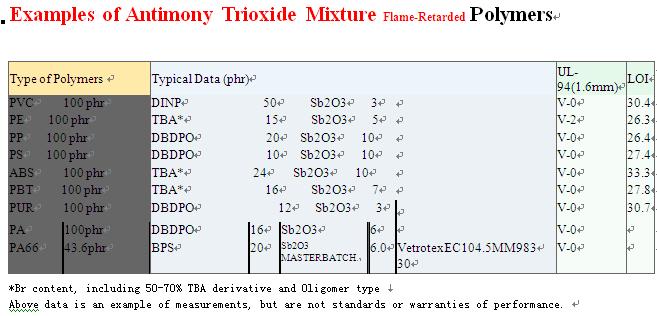
Examples of Antimony Trioxide Mixture Flame-Retarded Polymers